


Page 20 - Zakynthos Tourist Guide 2025
P. 20
20


        Ζakynthos


        HOMELAND OF
        IMPORTANT
        PERSONALITIES
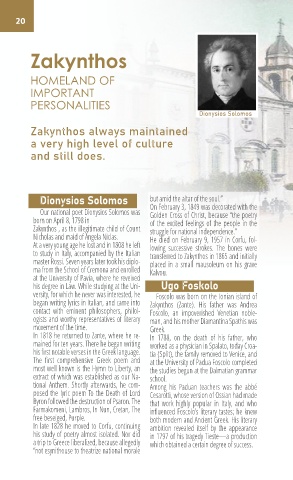
                                                  Dionysios Solomos

        Zakynthos always maintained
        a very high level of culture
        and still does.


             Dionysios Solomos        but amid the altar of the soul.”
             Our national poet Dionysios Solomos was   On February 3, 1849 was decorated with the
                                      Golden Cross of Christ, because “the poetry
         born on April 8, 1798 in     of the excited feelings of the people in the
         Zakynthos , as the illegitimate child of Count   struggle for national independence.”
         Nicholas and maid of Angela Niclas.  He died on February 9, 1957 in Corfu, fol-
         At a very young age he lost and in 1808 he left   lowing  successive  strokes.  The  bones  were
         to study in Italy, accompanied by the Italian   transferred to Zakynthos in 1865 and initially
         master Rossi. Seven years later took his diplo-  placed in a small mausoleum on his grave
         ma from the School of Cremona and enrolled   Kalvou.
         at the University of Pavia, where he reveived
         his degree in Law. While studying at the Uni-     Ugo Foskolo
         versity, for which he never was interested, he      Foscolo was born on the Ionian island of
         began writing lyrics in Italian, and came into   Zakynthos  (Zante).  His  father  was  Andrea
         contact  with  eminent  philosophers,  philol-  Foscolo,  an  impoverished  Venetian  noble-
         ogists and worthy representatives of literary   man, and his mother Diamantina Spathis was
         movement of the time.        Greek.
         In 1818 he returned to Zante, where he re-  In  1788,  on  the  death  of  his  father,  who
         mained for ten years. There he began writing   worked as a physician in Spalato, today Croa-
         his first notable verses in the Greek language.  tia (Split), the family removed to Venice, and
         The  first  comprehensive  Greek  poem  and   at the University of Padua Foscolo completed
         most well known is the Hymn to Liberty, an   the studies begun at the Dalmatian grammar
         extract of which was established as our Na-  school.
         tional Anthem. Shortly afterwards, he com-  Among  his  Paduan  teachers  was  the  abbé
         posed the lyric poem To the Death of Lord   Cesarotti, whose version of Ossian had made
         Byron followed the destruction of Psaron. The   that work highly popular in Italy, and who
         Farmakomeni, Lambros, In Nun, Cretan, The   influenced Foscolo’s literary tastes; he knew
         free beseiged, Purple.       both modern and Ancient Greek. His literary
         In late 1828 he moved to Corfu, continuing   ambition  revealed  itself  by  the  appearance
         his study of poetry almost isolated. Nor did   in 1797 of his tragedy Tieste—a production
         a trip to Greece liberalized, because allegedly   which obtained a certain degree of success.
         “not esynithouse to theatrize national morale

